

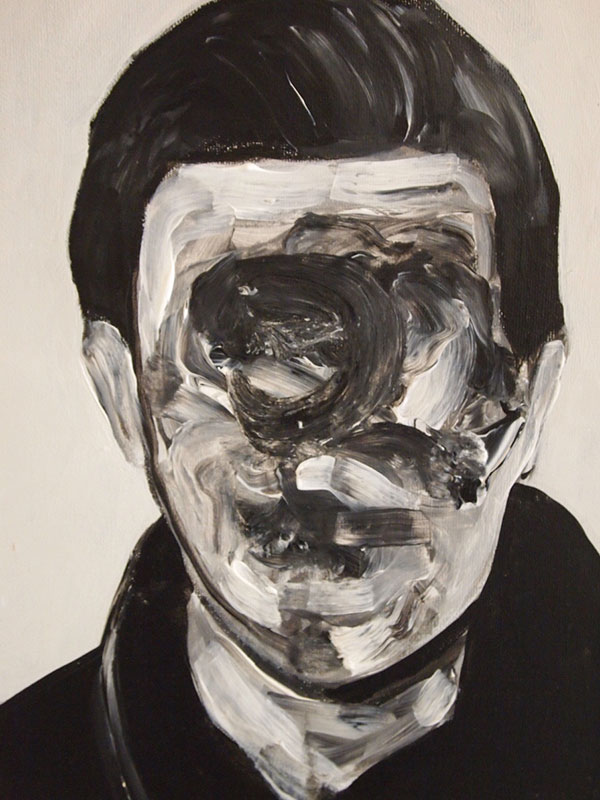
Spanish-born, London-based artist Miguel Laino occupies a space where the visceral meets the ethereal. He is doing some art defacing paintings I like. His work is a masterclass in the "honest mistake"; a deliberate leaning into the subconscious where the human form is both celebrated and dismantled.
Here is a review of his artistic style, methodology, and thematic core.
1. The Aesthetic of "Controlled Chaos"
Laino’s work is immediately recognizable by its raw, gestural quality. Transitioning from a high-profile background in fashion (having worked with Alexander McQueen and Vivienne Westwood), he abandoned the rigid precision of garment construction for the "ugly-beautiful" freedom of figurative painting.
- The Palette: He often employs a muted, earthy Andalusian palette; siennas, ochres, and deep shadows; punctuated by startling "shocks" of synthetic color.
- The Surface: His canvases are heavily worked. There is a sense of "defacing" his own subjects, using layered collage and textured finishes that suggest age and decay while remaining vibrantly modern.
2. The Metaphysics of the Figure
Laino’s subjects often appear as if they are in the middle of a molecular shift. Drawing from Aristotelian metaphysics (the concept of being qua being), his figures are not static portraits but explorations of "essence."
- Exaggerated Limbs: You will often see hands that are pointedly enlarged or limbs that seem heavy and dangling. This serves as a metaphor for the "helplessness" of the soul trapped in a physical form.
- Disillusion & Dissolution: His work frequently touches on entropy. Figures often blur into their surroundings; a chair becomes part of a torso, or a face dissolves into the background; reflecting the Buddhist and Eastern philosophical ideas of the impermanence of the self.
3. Methodology: The "Digital Scavenger"
Unlike traditional portraitists who work from life, Laino is a "hunter" of images. He searches the deep web, Japanese blogs, and obscure newspapers for black-and-white source material.
- Reclaiming the Image: By taking a "found" image and applying his own spontaneous color choices, he strips the subject of its original context and breathes a "murky, dreamlike" life into it.
- Speed and Honesty: He famously works fast—often finishing large canvases in a single day. This prevents "conceptual interference," allowing the subconscious to dictate the brushwork rather than a pre-planned narrative.
4. Critical Summary
To look at a Miguel Laino painting is to feel a sense of familiarity crossed with alienation. He captures the "glitch" in the human experience; the moments where we feel disconnected from our bodies or overwhelmed by the chaos of existence.
His work doesn't ask you to understand a story; it asks you to sit with the ambiguity. It is "striking without being loud," making it as much a philosophical inquiry as it is a visual experience.
Key Influence: If you enjoy the distorted psychological depth of Francis Bacon or the raw figuration of Georg Baselitz, Laino’s work will likely resonate with you.